
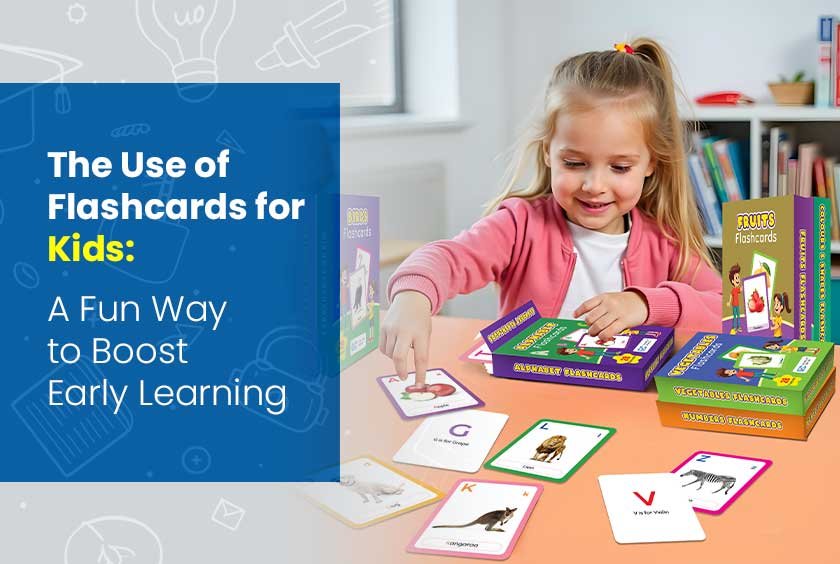
When it comes to early childhood education, flashcards are one of the simplest yet most powerful learning tools. Whether you’re teaching your child the alphabet, numbers, animals, or shapes, flashcards make learning interactive, visual, and fun.
In this blog, we’ll explore why flashcards are so effective for kids and how you can use them to make learning exciting.
What Are Flashcards?
Flashcards are small cards containing pictures, words, or both, designed to help children learn new concepts quickly. They can be used to teach:
-
Letters
-
Numbers & counting
-
Shapes & colours
-
Animals, fruits, and vegetables
-
Everyday objects and actions
Their simple format makes them easy to use anywhere—at home, in classrooms, or even during travel.
Benefits of Using Flashcards for Kids
a) Improves Memory and Recall
Flashcards encourage active recall, a learning technique proven to strengthen memory. Repeated exposure helps children remember and identify concepts faster.
b) Makes Learning Fun
With colourful images and playful designs, flashcards turn study time into a game—keeping kids engaged and excited.
c) Enhances Vocabulary
By pairing pictures with words, flashcards help children connect visuals with language, boosting their vocabulary and comprehension.
d) Encourages Parent-Child Interaction
Flashcards are a great way for parents to spend quality learning time with their children, fostering both education and bonding.
e) Portable and Versatile
They’re lightweight, easy to carry, and can be used for quick learning sessions anytime, anywhere.
Why Flashcards Work
-
Boost Memory: Repetition improves recall.
-
Build Vocabulary: Pictures + words = faster learning.
-
Make Learning Fun: Turn lessons into games.
-
Encourage Bonding: Perfect for parent-child time.
-
Portable: Learn anywhere, anytime.
How to Use Them
- Start with 5–10 cards.
- Keep it playful and interactive.
- Shuffle for variety.
- Practice daily for best results.
Conclusion: Flashcards are more than just cards—they’re a fun, interactive path to learning success.